Reach your first triathlon finish with confidence
Learn how swimming, cycling and running work together without overloading every week.
TRIATHLON COACHING
Swimming, cycling, running, recovery, nutrition and everyday life are planned as one connected process – from your first finish to an ambitious goal.
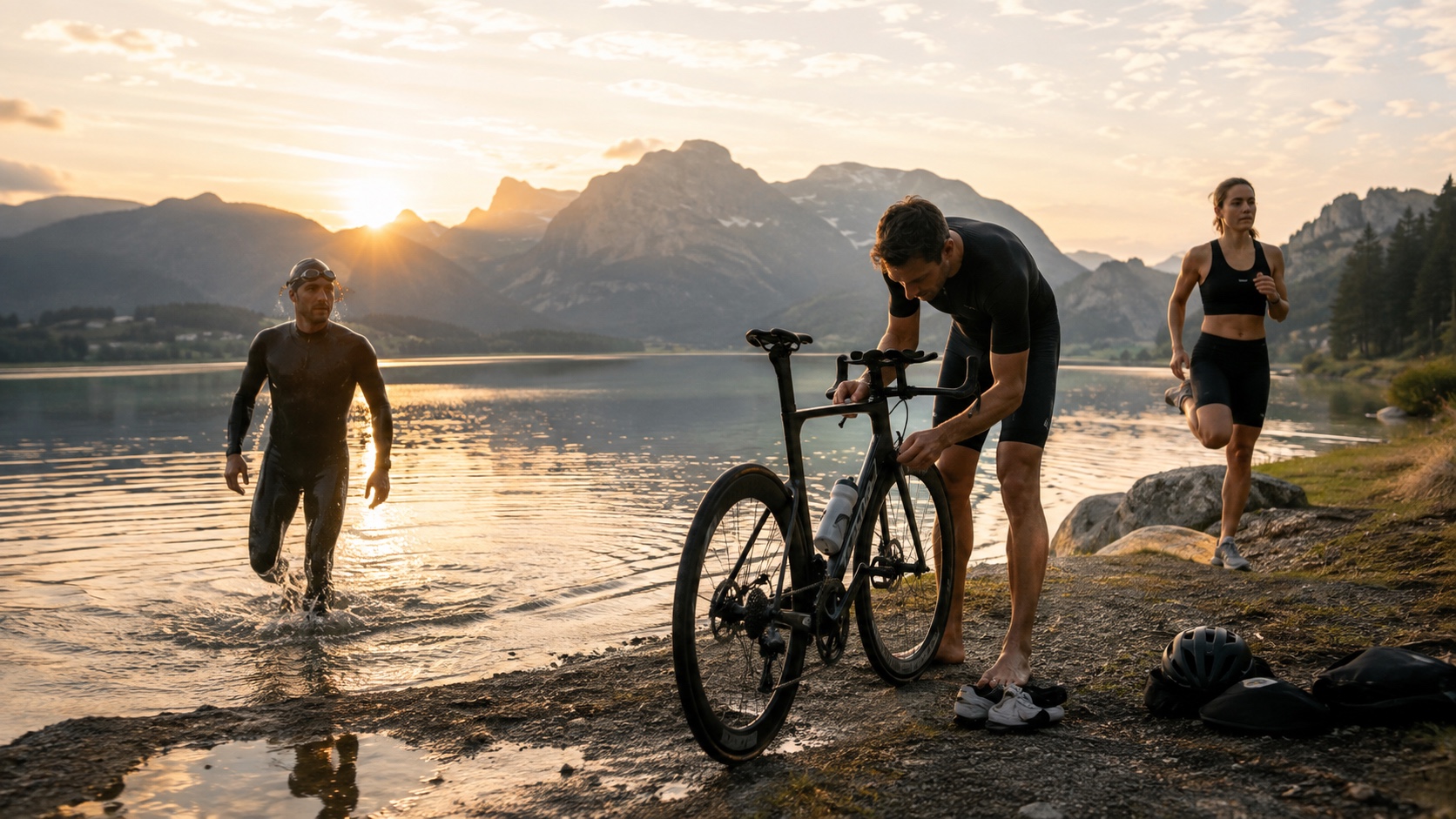
The key is how three disciplines, your race goal and the time available each week fit together.
Learn how swimming, cycling and running work together without overloading every week.
Season phases, intermediate goals and race pace build on one another in a clear sequence.
The most important sessions keep their priority while the rest of the week remains adaptable.
Load and recovery need to work across swimming, cycling and running, not only within one discipline.
Hard and long sessions do not compete by accident; they are placed so development and recovery remain balanced.
Specific work is added when it fits your distance, season phase and ability to absorb the load.
Power, pace, heart rate and completed load are read alongside your own feedback and everyday life.
An example of the planning logic. Your actual week is shaped by your goal, training status and everyday life.
| Day | Focus | Specific example |
|---|---|---|
| Monday | Rest day and weekly check | Rest day. Briefly review recovery, appointments and available training time; no training session. |
| Tuesday | Run intervals | Run: about 60 min including warm-up, 5 × 5 min at a brisk effort and 2 min easy recovery. Guided by pace, heart rate and RPE according to the goal. |
| Wednesday | Easy swim | Swim: about 60 min of technique work and steady aerobic endurance without an interval set. Guided by clean technique and RPE. |
| Thursday | Bike intervals | Bike: about 75 min with 3 × 10 min in the prescribed intensity range and 5 min easy between. Guided by FTP/power or heart rate, supported by RPE. |
| Friday | Stability & short swim intervals | Double session: first about 30 min of controlled strength, conditioning and stability work; then about 45 min of swimming including warm-up and 12 × 50 m brisk with 20 sec easy rest. Guided by Critical Swim Speed (CSS) or RPE 6–7/10 while technique stays clean. |
| Saturday | Long run | Run: about 75–100 min easy and steady. Guided by pace, heart rate or RPE; where appropriate, deliberately open as a fartlek. |
| Sunday | Long ride with brick run | Bike: about 2:30–3:00 h followed by a 15–20 min easy brick run. Guided by power, heart rate and RPE; planned fueling is tested under realistic conditions. |
Choose ongoing personal coaching or a clearly scoped technique service.
Together we review your goal, training status, everyday life and the right level of personal support.
Request an introductory conversation PERSONAL COACHINGI plan your training and adapt it to your development and everyday life.
Triathlon packages & prices TECHNIQUEDedicated one-to-one and video-analysis services focus specifically on your swimming technique.
View technique servicesWhat you may want to know before you start.
Sprint, Olympic, middle and long distance are planned according to your starting point, goal and available preparation time.
Yes. Race date, distance and available weeks are considered in the orientation and personal season plan.
A deliberate reduction in training load before a race so recovery and readiness can come together.
The final week before a race, with reduced volume, suitable activation and clear organisational preparation.
As a broad guide, long-distance or Ironman preparation often needs around 10 to 12 months, while middle distance often needs around 6 to 10 months. The actual period depends on fitness, experience, starting point and weekly time.
Main and secondary races are organised into a season sequence according to goals, recovery and load consequences.
NEXT STEP
The package finder gives you a primary recommendation, an alternative and the main reasons.
Find the right offer